







Economy Policy
Can one-third reservation in Parliament solve India’s female workforce dropout problem?





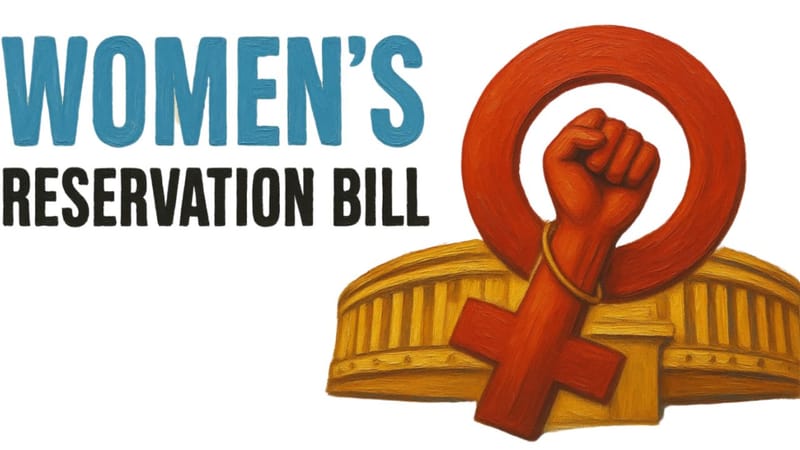
Women’s reservation targets numbers in politics, but the real deficit lies in jobs and careers.
India is trying to fix a representation problem in Parliament. The real test is whether it accidentally fixes a much bigger one in the economy.
As the Lok Sabha debates a fresh push to operationalise one-third reservation for women through amendments and delimitation-linked bills, the conversation has quickly spilled beyond politics. The question now is this: can more women in legislatures translate into more women in jobs, leadership roles and payrolls?
The answer, if you follow the data trail, is not straightforward. Representation may open doors. But the workforce story suggests those doors often lead to corridors filled with structural barriers.
A political correction, long delayed
The legislative push builds on the Nari Shakti Vandan Adhiniyam, passed in 2023, which mandates 33 per cent reservation for women in the Lok Sabha and state assemblies. The current set of bills aims to accelerate implementation by linking it to a delimitation exercise based on the latest available census data.
The proposed Constitution (One Hundred and Thirty-First Amendment) Bill, 2026 seeks to increase Lok Sabha seats from 543 to 850, enabling the quota to be operationalised sooner rather than waiting for a future census cycle. The Delimitation Bill, 2026 and amendments to Union Territories laws are designed to align constituencies with this new framework.
The political intent is explicit. Prime Minister Narendra Modi said during the debate that women, who constitute roughly half the population, must be part of decision-making, adding that their participation is central to the country’s development trajectory.
On paper, this is a structural reset. In practice, it is a test of whether political inclusion can trigger economic inclusion.
The workforce reality check
If Parliament is underrepresenting women, the labour market is doing far worse.
India’s female labour force participation sits at around 40.3 per cent, according to a FICCI FLO report cited by BW Businessworld. Another estimate cited in The Times of India, based on the Periodic Labour Force Survey 2023-24, suggests that nearly 60 per cent of women are entirely outside the labour force.
That is not a marginal gap. That is a systemic exclusion.
Even where participation improves, the quality of employment tells a different story. The Economic Survey 2026 warned that without meaningful gains in women’s workforce participation, India could face a 20 per cent GDP shortfall, according to The Times of India.
This is where the reservation debate begins to intersect with economics. Representation is not just a democratic metric. It is increasingly a productivity variable.
Education in, employment out
The pipeline problem begins early and worsens over time.
Women account for 48 per cent of university enrolments, but only 33 per cent of entry-level roles and 24 per cent of managerial positions, according to a McKinsey study cited by The Times of India.
That drop is not random leakage. It is structured attrition.
The FICCI FLO report highlights a critical inflection point between three and eight years of experience, when career breaks, care responsibilities and workplace rigidity converge. Missing even one promotion cycle during this phase can permanently reduce the probability of reaching leadership roles, creating what the report terms a “career compounding loss”.
In simpler terms, the system is not failing women occasionally. It is failing them predictably.
Representation versus participation
This is where the optimism around political reservation meets a harder question. Does representation at the top change behaviour across systems?
There is some precedent. Prime Minister Modi pointed out that around 2,700 of 6,700 block Panchayats are led by women, according to All India Radio. That shift at the grassroots level has, in past studies, been associated with changes in local governance priorities such as education, water and health.
But scaling that effect to the national economy is not automatic.
Political representation can influence policy design. It can shape budgets, incentives and regulatory frameworks. It can push for better childcare infrastructure, safer transport, flexible work norms and return-to-work programmes. These are precisely the barriers flagged in workforce data.
Yet, the distance between legislation and lived workplace experience remains significant.
The services sector paradox
Consider the services sector, which contributes nearly 55 per cent of India’s gross value added, according to the FICCI FLO report cited by BW Businessworld.
Despite this dominance, women remain underrepresented in high-growth segments. Their share stands at 36 per cent in tech and BPM, 35 per cent in BFSI, 20 per cent in professional services, 18 per cent in hospitality and just 12 per cent in logistics.
This is not a supply issue. Entry-level hiring often achieves near parity. The problem is retention and progression.
The same report notes that industries with rigid shifts, unsafe commutes and unpredictable hours see the steepest drop-offs. In contrast, sectors with predictable schedules, such as education, show better retention.
In effect, the labour market is selecting for structural convenience, not capability.
The re-entry wall
One of the most stubborn barriers is the re-entry problem.
The Times of India reports that a significant number of women who take career breaks struggle to return due to skill gaps, bias and lack of structured pathways. The cost of reskilling adds another layer of friction.
The FICCI FLO report estimates that around 2.1 lakh women in tech are currently on career breaks, with nearly 58 per cent considered potentially re-employable.
This is not just a talent pool. It is a missed economic opportunity.
Political representation could influence this space by pushing for policy-backed returnship programmes, tax incentives for companies hiring returning women, or public funding for reskilling initiatives. But those are second-order effects, not immediate outcomes.
Can policy nudge behaviour?
The strongest case for economic impact lies in policy spillover.
If more women enter legislatures, the probability of gender-sensitive policymaking increases. That could mean stricter enforcement of workplace safety norms, expanded maternity and childcare support, and incentives for diversity in leadership pipelines.
The FICCI FLO report already calls for treating childcare as infrastructure, enforcing safe commute standards and mandating transparent diversity disclosures. These are policy levers, not corporate goodwill exercises.
The question is whether political reservation accelerates their adoption.
The limits of symbolism
There is also a risk of overestimating the impact.
Reservation ensures representation, not necessarily influence. Legislative presence does not automatically translate into policy dominance. Nor does policy automatically reshape corporate behaviour.
Opposition leaders have already questioned the timing and design of the bills, particularly the linkage with delimitation, as reported by Indian Express and Hindustan Times. The political contestation suggests that the rollout itself may face delays or compromises.
In that scenario, the economic spillover becomes even more uncertain.
What changes, what does not
What is likely to change is visibility. More women in Parliament can normalise leadership at scale. It can reshape aspirations and narratives.
What is harder to change is infrastructure. Workplace design, mobility, safety, caregiving support and career progression systems require coordinated intervention across government and industry.
The data makes one thing clear. India’s gender gap in employment is not about entry. It is about endurance.
If representation leads to policy reform that addresses structural barriers, the effects could be significant. If it remains a numbers exercise, the workforce story may not shift meaningfully.
Topics
Author
Loading...
Loading...