







AI & Emerging Tech
TCS could soon have as many AI agents as employees, says chairman N Chandrasekaran





India’s largest IT services company sees AI agents becoming a core part of its workforce model, with Chairman N Chandrasekaran signalling slower hiring as automation reshapes the industry.
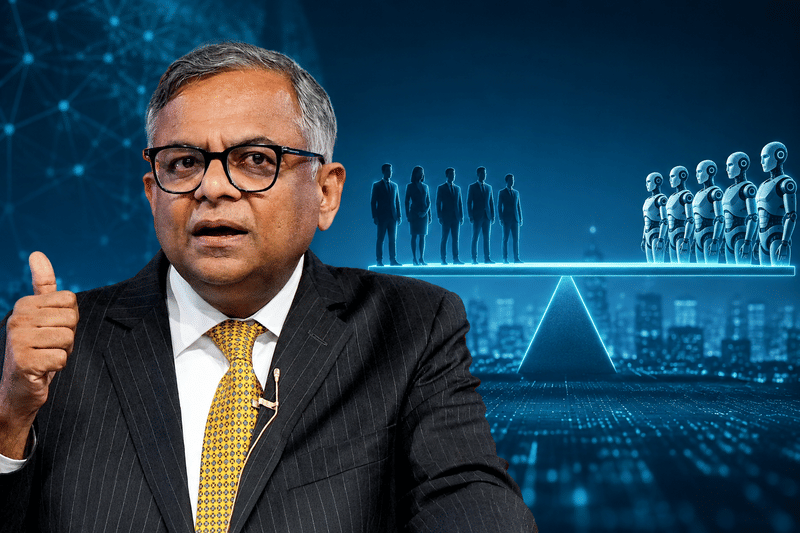
Tata Consultancy Services (TCS) could eventually deploy as many artificial intelligence agents as it has employees, according to Chairman N Chandrasekaran, who said the technology would increasingly work alongside human staff and alter hiring patterns across the IT sector.
Speaking at the company’s annual general meeting on Tuesday, Chandrasekaran said the future workforce at TCS would comprise both employees and AI agents, reflecting the rapid adoption of artificial intelligence across enterprise operations.
“If the company has half a million employees, the day is not far when the company will have half a million AI agents,” Chandrasekaran said, according to Reuters. He added that employees and AI agents would work together as part of the company’s future operating model.
The remarks come at a time when the global technology industry is assessing how generative AI and automation could transform traditional services businesses that have historically relied on large workforces to deliver projects.
AI adoption expected to reshape hiring
Chandrasekaran said TCS does not intend to reduce its workforce but expects hiring to slow as AI agents take on a growing share of routine and repeatable work.
According to Reuters, he said increased deployment of AI agents would reduce the number of people recruited by both TCS and the wider IT industry as certain tasks become automated.
At the same time, he indicated that AI-driven transformation would create new categories of work and opportunities for employees as organisations adapt to new operating models.
His comments arrive amid growing debate over the long-term impact of AI on employment across the technology sector, particularly in India, where IT services companies collectively employ millions of professionals.
A changing landscape for India’s IT industry
India’s IT sector, valued at approximately $315 billion, has faced investor scrutiny over whether AI could disrupt the labour-intensive business model that has underpinned the industry’s growth for decades.
The sector has already witnessed a moderation in hiring activity amid softer client spending, economic uncertainty and geopolitical challenges affecting technology budgets.
As India’s largest IT services company by both market capitalisation and employee base, TCS is often viewed as a bellwether for broader industry trends.
Key developments highlighted by Reuters include:
• TCS does not plan workforce downsizing but expects lower hiring levels in future.
• The company reduced more than 12,000 jobs in July last year.
• Net headcount declined by more than 23,000 during the financial year ended March 2026.
• TCS shares have fallen more than 32% in 2026 so far, compared with a decline of about 25% in the Nifty IT index.
The comments underline how major technology services firms are increasingly integrating AI into delivery models while balancing workforce requirements.
AI revenue becomes a larger growth driver
TCS has been expanding its AI-related offerings as clients seek to automate processes, improve productivity and modernise operations.
Chandrasekaran said the company’s annualised AI revenue exceeded $2.3 billion in the quarter ended 31 March, highlighting the growing commercial significance of artificial intelligence within its business.
He also projected that AI would become embedded across the company’s operations over the coming years, stating that 100% of TCS revenue would have an AI component before the end of the decade.
That outlook reflects a broader industry shift in which AI is moving from experimental deployments to becoming a central element of enterprise technology spending.
The next phase of workforce transformation
The emergence of AI agents capable of performing specific tasks is increasingly influencing how technology companies plan staffing, project delivery and operational efficiency.
While Chandrasekaran acknowledged that some work currently performed by people would transition to AI systems, he emphasised that the change would be part of a wider evolution affecting companies, industries and economies.
For TCS, the challenge now lies in balancing workforce development with AI adoption as demand for automation accelerates. As enterprises deepen their use of artificial intelligence, the company’s vision of employees and AI agents working side by side may offer a glimpse into how the future IT workforce is likely to evolve.
Topics
Author
Loading...
Loading...